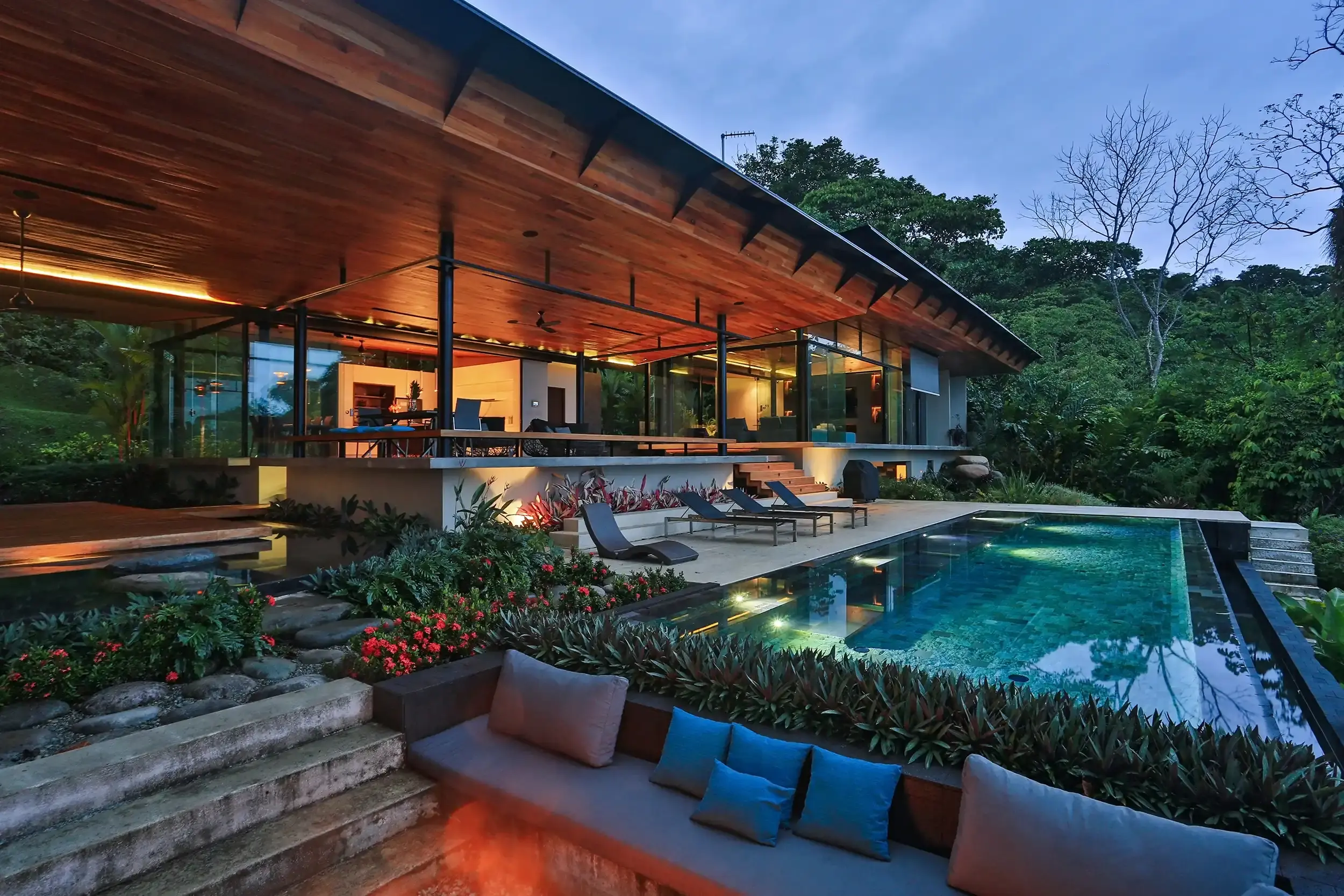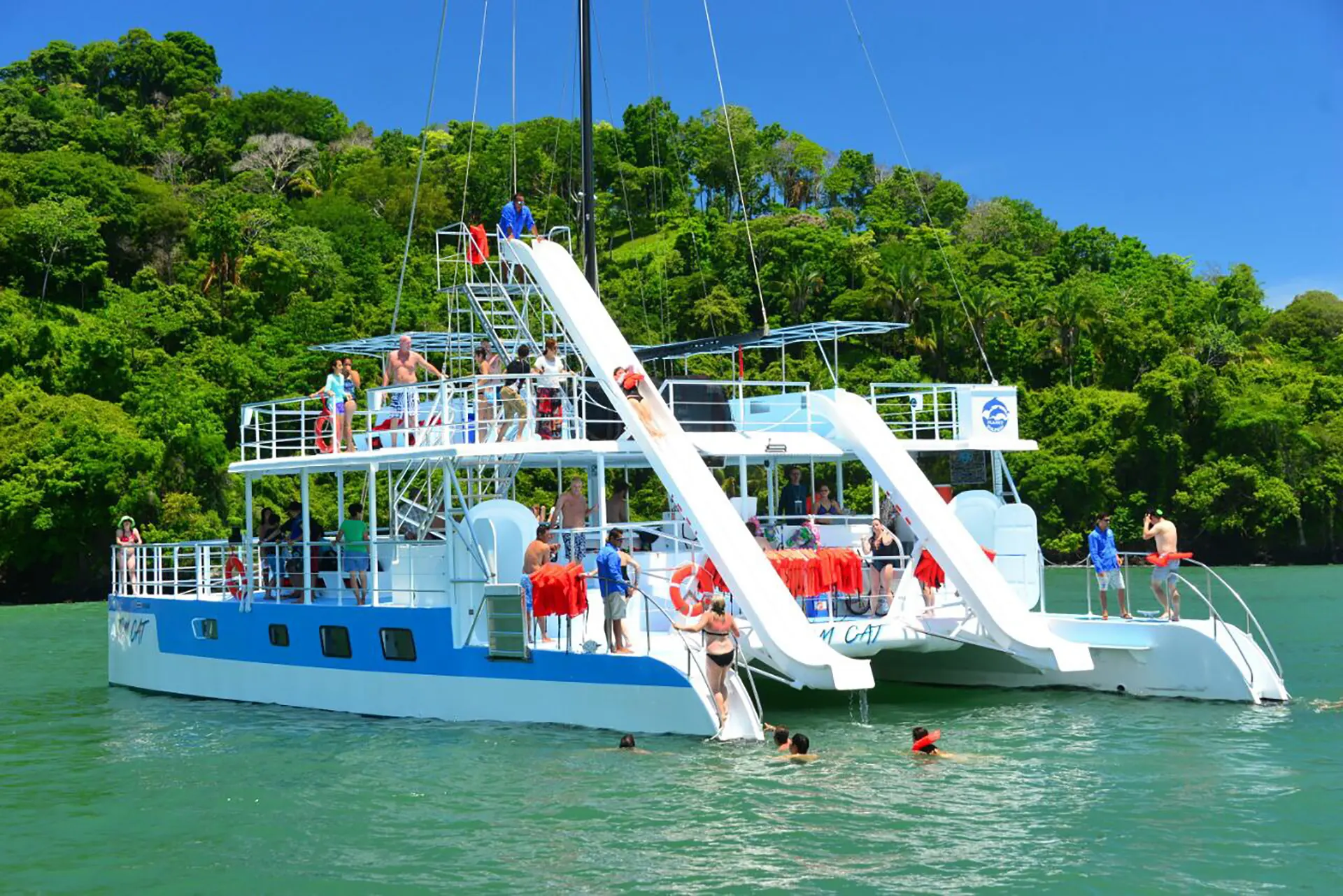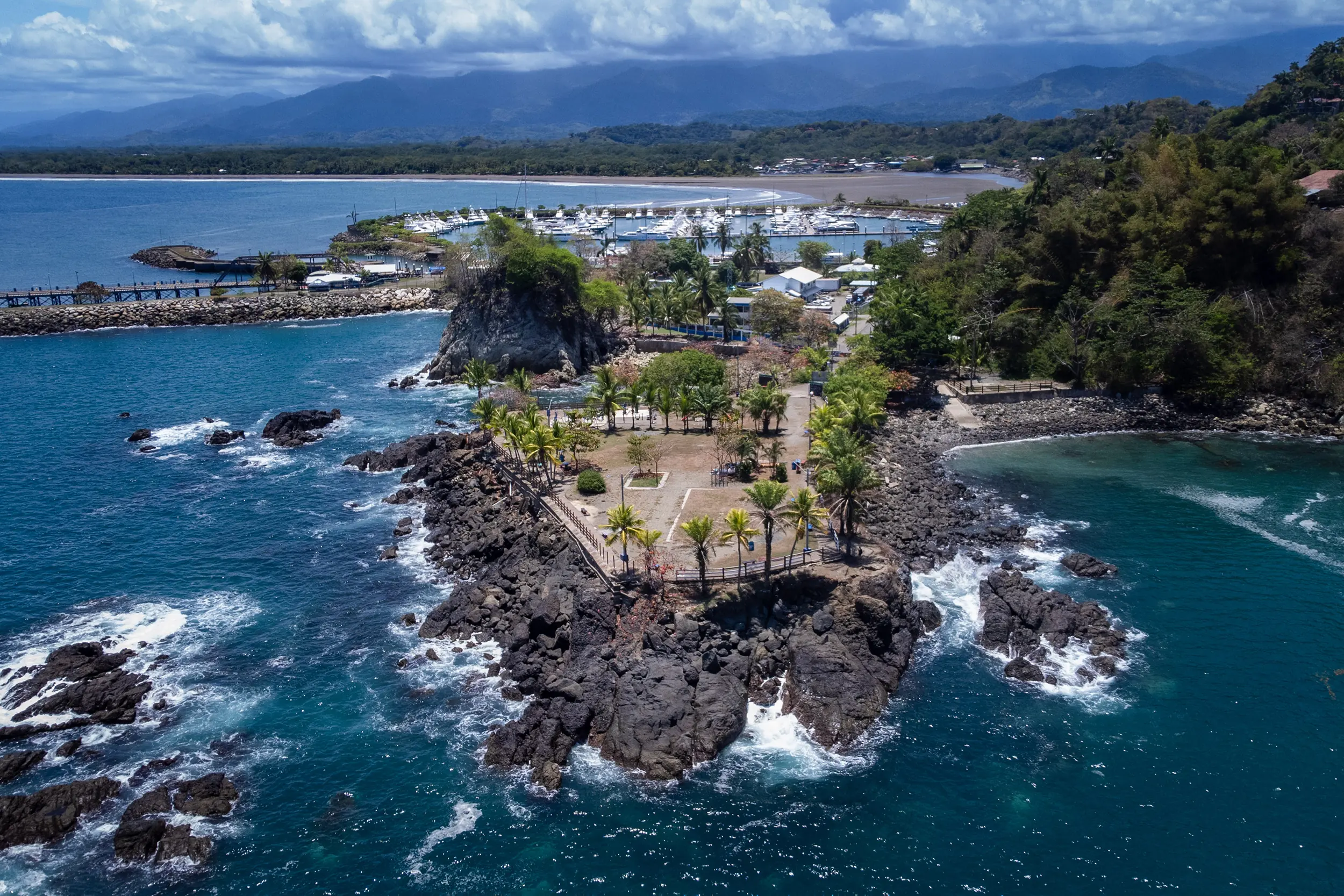
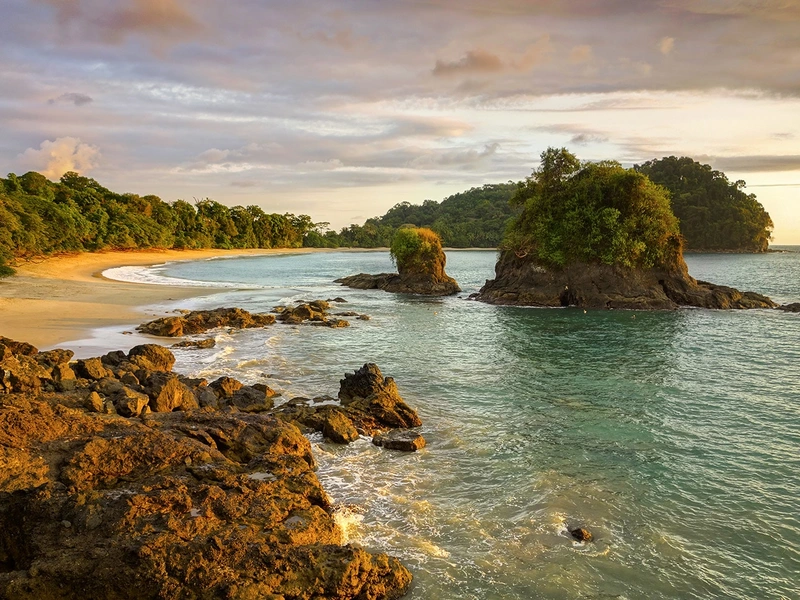
Almost every villa in this country is beautiful. That is genuinely true, and it is also why choosing is hard: the photos all look the same. What actually differs is the land around the house, how far you drive to do anything, and what you see when you walk outside in the morning. Here is the honest version of that comparison, including the one place we would steer you away from.
Manuel Antonio: our pick, and where we live
We live here rather than in any of the other places on this list, so treat this as an opinion with a bias attached. The reason is density. Manuel Antonio is the one spot where rainforest runs straight into the ocean, and everything a group wants is inside a twenty-minute radius.
What that means in practice:
- Wildlife you actually see. Sloths, capuchin and squirrel monkeys, toucans, and scarlet macaws, the lapas, which fly the coast here in loud red and blue pairs and are the bird everyone ends up photographing. Often from the villa terrace before you have left the property. The national park is one of the most reliable places on earth to see the monkeys and sloths in a single morning walk.
- A national park you can do in half a day. Flat coastal trails, not a hike, connecting several swimmable beaches. Good with grandparents and good with a four-year-old.
- Ocean and jungle at once. The ridge above town is lined with villas that look down over both. You get the view and the monkeys without giving up the beach.
- Everything else within half an hour. Offshore fishing out of Marina Pez Vela, whitewater rafting on three different rivers, ziplines, mangrove kayaking, waterfalls, surf lessons. No day trip requires a pre-dawn start.
- Real restaurants. The ridge road has proper ocean-view kitchens, not just beach shacks, which matters when you are somewhere for ten nights.
The trade-offs, honestly: it is the most visited part of the country, so the park needs a reservation and the town is busy in dry season. It is a hill, so most villas mean stairs and a drive to the sand. And it is three to three and a half hours from San José airport, which is a real travel day. Worth knowing, though: you do not have to drive it. There is a domestic flight from San José into Quepos that takes about twenty minutes in the air and runs around a hundred dollars a person, which turns the worst part of the trip into the shortest.
On four-wheel drive: you do not need one. The main road, the park, the beaches, and most villas are fine in a normal car. It is preferred rather than required, and it earns its keep only if you want to get up into the mountains behind town, where the roads go steep and unpaved. A handful of specific houses do require one, and we say so on the listing rather than letting you find out at the bottom of the hill.
Guanacaste: ocean without the jungle
If your group wants the beach and the sun but not the rainforest, this is the answer, and for some groups it is the better one. Guanacaste is the northern Pacific: drier, flatter, hotter, and built around beach communities rather than a hillside.
- The airport is close. Liberia is 30 to 90 minutes from most beaches, against three-plus hours from San José to the central coast. For a group with small kids, that difference is the whole first day.
- Flat ground. Gated communities, level driveways, ground-floor bedrooms. If anyone in the group has a bad hip or a walker, this is where to go.
- Bigger houses. More eight to twelve bedroom single properties than the central coast, where groups above sixteen usually need two houses.
- Reliable dry weather. Guanacaste gets noticeably less rain than the central and south Pacific, and the dry season runs longer.
- Beach clubs and golf. Hacienda Pinilla, Conchal, and the Papagayo area are built around that resort infrastructure in a way Manuel Antonio simply is not.
What you give up: wildlife density. You will see howler monkeys and iguanas, but not the constant sloth-and-toucan traffic of the central coast. There is no equivalent of Manuel Antonio National Park up there, and the landscape is dry forest rather than rainforest, which is beautiful but browner outside the green season.
Arenal: the same adventure, no ocean
Arenal is the one inland option we would genuinely recommend. If your group is here for nature and adrenaline rather than beach time, it delivers as much as the central coast does.
- The volcano. A near-perfect cone over the town of La Fortuna, with national park trails through old lava fields.
- Hot springs. Volcanically heated rivers, channeled into everything from casual pools to serious resorts. An evening soak with the cone in the distance is the signature thing to do there.
- Caving. The Venado caves nearby are a proper caving experience, wading through underground chambers with a helmet and a lamp. There is nothing like it on the coast.
- Rafting, hiking, and ziplines. Same menu as Manuel Antonio, different scenery, plus hanging bridges through the canopy and a waterfall you walk several hundred steps down into.
What you give up is the ocean, entirely. It is also several hours by road from the Pacific coast, so treat Arenal as its own trip or as one half of a two-base itinerary, never as a day trip.
Dominical and Uvita: quieter, wilder, less polished
Thirty minutes south of Manuel Antonio, the coast gets emptier fast. Dominical is a surf town with dirt roads, and Uvita is the whale-watching capital, with the sandbar at Marino Ballena that forms the shape of a whale's tail at low tide. Humpbacks pass through for most of the year across two separate migrations.
Come here if you want long empty beaches, waterfalls, and jungle houses with nobody around. Skip it if your group wants restaurants, nightlife, or easy logistics, because everything is further apart and some of the roads are rough.
Jaco: the one we would skip
We will be straight about this one. Jaco is the closest beach town to San José, an hour and a half to two hours, and that convenience is its main argument. It is a party town: the widest range of bars, clubs, and late restaurants on the coast, plus casinos, concentrated in a few walkable blocks.
If that is the trip your group wants, Jaco does it better than anywhere else on the Pacific. There is a forgiving beach break for first-time surfers, Los Sueños marina ten minutes north for offshore fishing, and Carara National Park up the road for scarlet macaws.
But if you came to Costa Rica for nature, wildlife, and adventure, this is the wrong town. It is not nature-first and it does not pretend to be. Groups who book it because it is close to the airport usually realize by day two that they are an hour and a half from the country they came to see.
What you will actually see, by region
This is the part most comparisons skip, and it is the thing people remember from the trip. Wildlife is not evenly spread around this country: each region has its own cast.
Manuel Antonio and the central Pacific. Three-toed and two-toed sloths, white-faced capuchin monkeys, squirrel monkeys (the small orange ones, found almost nowhere else in the country), howler monkeys, toucans, scarlet macaws, called lapas here and impossible to miss once you learn their call, green iguanas, basilisk lizards running across water, agoutis, coatis, and raccoons that will absolutely open your cooler. Crocodiles and herons in the Damas mangroves, humpback whales offshore in season, and sailfish, marlin, dorado and roosterfish beyond the reef.
Guanacaste. Howler monkeys, white-faced capuchins, iguanas everywhere, magpie jays, parakeets, and coatis. The dry forest brings animals you do not get further south, including white-tailed deer and, if you are lucky and quiet, a coyote or an anteater. The headline act is nesting sea turtles: leatherbacks at Playa Grande in the Marino Las Baulas park and olive ridleys in enormous synchronized arrivals at Ostional. No squirrel monkeys and no sloths to speak of, which is the honest trade.
Arenal. Howler monkeys, sloths, coatis, peccaries, poison dart frogs and red-eyed tree frogs, an enormous bird list including toucans and motmots, and bats in the Venado caves. Night walks here are excellent because the frogs come out. No ocean species, obviously.
Dominical and Uvita. The same central Pacific cast as Manuel Antonio, with more of it and fewer people watching: sloths, all four monkey species in places, toucans, and scarlet macaws that have been recovering well along this stretch of coast, often in pairs over the beach at first light. Plus the thing the area is known for, humpback whales passing Marino Ballena across two separate migrations that cover most of the year, along with dolphins.
Jaco. Limited in town itself. The wildlife is a drive away: scarlet macaws and crocodiles at Carara National Park and along the Tarcoles River, which is genuinely one of the best macaw spots in the country. In town, expect iguanas and not much else.
The comparison, side by side
| Manuel Antonio | Guanacaste | Arenal | Dominical and Uvita | Jaco | |
|---|---|---|---|---|---|
| Airport | San José, 3 to 3.5 hrs | Liberia, 30 to 90 min | San José, 2.5 to 3 hrs | San José, about 4 hrs | San José, 1.5 to 2 hrs |
| Land | Rainforest hillside | Dry, flat, coastal | Volcano and rainforest | Steep jungle coast | Flat beach town |
| Ocean | Yes, plus jungle | Yes, the main event | None | Yes, wild and empty | Yes, surf beach |
| Wildlife | Best on this list | Moderate | Very good, different species | Excellent, whales in season | Limited in town |
| Best for | Mixed groups who want everything close | Flat ground, big houses, short transfer | Adventure without beach | Quiet, wild, unpolished | Nightlife and surf |
| Think twice if | Stairs are a problem | You came for rainforest | You want ocean | You want restaurants and easy roads | You came for nature |
The mistake we see most: too many places
Almost every week someone sends us a plan that reads like this. Two nights in La Fortuna, then drive to Monteverde for two nights, then down to Manuel Antonio for two, then back to San José to fly home. It is a real option and plenty of people do it. We still think it is the wrong way to spend a week here.
The problem is what it costs you that does not show up on the itinerary. Every move is three to five hours on winding roads, plus packing, checking out, checking in, finding dinner somewhere unfamiliar, and working out where the good beach is all over again. Do that three times in seven days and you have spent two full days in a car and never once woken up somewhere that felt like yours.
The trips people rave about afterwards are the ones where they picked a place and stayed. You learn which restaurant is actually good. The staff know your kids' names. You find the beach nobody else is on, and you go back to it. And you still do everything, because in a region like this the park, the boats, the rafting and the waterfalls are all half-day trips from the same house.
So our honest advice for seven to ten days: pick one area, or at most two. If you want two, make them genuinely different, beach on one side and volcano or cloud forest on the other, and give each at least three or four nights. Anything less than three nights somewhere is a visit, not a stay, and you will feel the difference on the drive home.
How to choose, in one line each
- Want everything in one place? Manuel Antonio.
- Travelling with grandparents, toddlers, or anyone who cannot do stairs? Guanacaste.
- Group of twenty or more in one house? Guanacaste, where the big single properties are.
- Here for adventure and not fussed about the beach? Arenal.
- Want to see nobody for a week? Dominical or Uvita.
- Here to go out every night? Jaco, and you will not need our help.
- Ten nights or more? Split it: Manuel Antonio plus Arenal is the pairing that works.
What to send us
Your dates, how many are coming, ages if there are kids or grandparents, and one sentence about what the group actually wants to do. We will tell you which region fits, which houses are open on those dates, and what it costs with tax included. If the honest answer is that a different coast suits you better, we will say so.