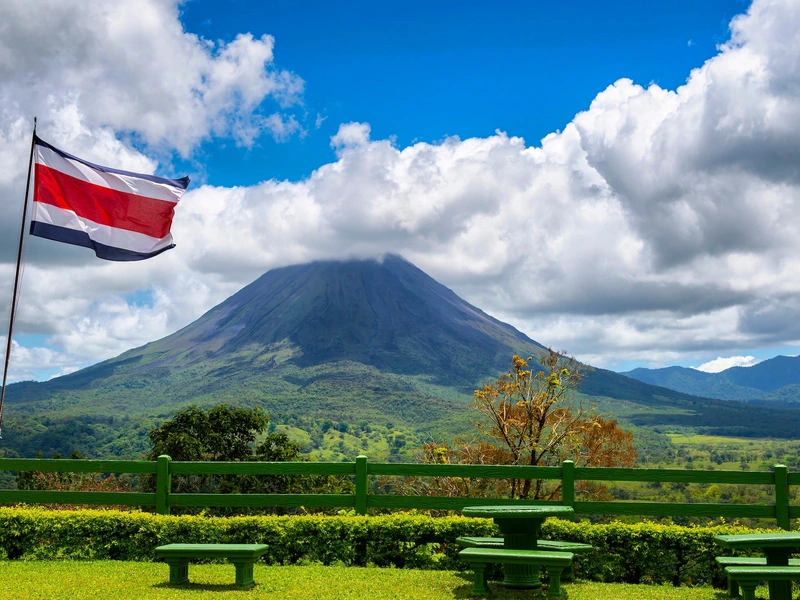
Arenal is Costa Rica's most recognizable volcano, a near-perfect cone rising over the small town of La Fortuna in the country's Northern Zone. For decades it was one of the most active volcanoes on earth, throwing glowing rock and ash visible for miles at night. It has been quiet since 2010, but the cone itself, the surrounding rainforest, and the geothermal activity underneath it still make this one of Costa Rica's signature destinations.
La Fortuna has grown into a full-service base for exploring the area, with hot springs resorts, canopy tours, and rainforest trails all within a short drive of town. It draws a different kind of traveler than the coast: less beach, more rainforest and adventure, with the volcano as a constant backdrop.
Hot springs. Rivers of volcanically heated water run through the area, and several resorts channel them into pools ranging from casual to luxury. An evening soak with the volcano lit up in the distance is the area's signature experience.
Hanging bridges. Mistico Arenal Hanging Bridges Park and similar parks nearby string suspension bridges through the rainforest canopy, a good way to see the forest from above without a long hike.
La Fortuna Waterfall. A roughly 200-foot waterfall a short drive from town, reached by a steep stairway of several hundred steps down into the canyon. There is a swimming area at the base when conditions allow.
Arenal Volcano National Park. Trails wind through old lava fields from past eruptions, including flows from 1968 and 1992, with viewpoints of the cone when the clouds cooperate. The summit itself is off limits.
Ziplining and canopy tours. The area is one of Costa Rica's original zipline destinations, with cables strung across rainforest canyons in view of the volcano.
Arenal Lake. Costa Rica's largest lake sits just past the volcano, good for kayaking, windsurfing, or a quieter boat ride with mountain views on all sides.
La Fortuna is about 115 kilometers (72 miles) from Juan Santamaría International Airport (SJO) near San José, roughly two and a half hours by road in light traffic, though three hours or more is realistic with stops and typical road conditions. This is genuinely far from our Central Pacific properties around Manuel Antonio, Uvita, and Jacó, several hours away by road, so we treat Arenal as its own trip rather than a day excursion. Most travelers add it as a standalone two to three night stay before or after coast time, and some choose a domestic flight to cut down the driving.
La Fortuna sits in its own rainforest microclimate, pulling moisture off both coasts, so it does not follow the Pacific coast's dry season and green season split as cleanly. Rain is possible in any month, July and October tend to be the wettest, and December through April is relatively drier with the best odds of a clear view of the cone. Expect warm, humid weather year-round with afternoon showers that usually pass within a few hours, and plan for rain regardless of when you travel.
Arenal is still classified as active, with occasional steam and gas venting from the crater, but it has been in a resting phase since its last eruption in October 2010. Climbing to the summit is illegal and has been for years, the slopes are unstable and the crater vents toxic gases. Guided trails around the base let you walk through old lava fields and get close views of the cone instead.
About 115 kilometers (72 miles) from Juan Santamaría International Airport, roughly two and a half hours in light traffic, though three hours or more is realistic once you account for stops and road conditions. A high-clearance vehicle is not required but is more comfortable, since parts of the route have rough pavement.
The waterfall park is open daily from 7 a.m. to 5 p.m., with last entry at 4 p.m. Entrance runs around 18 to 20 dollars for adults, with reduced pricing for children, and includes parking and access to the on-site trails and gardens. Confirm current pricing when you book, since fees can change.
La Fortuna sits in its own rainforest microclimate and gets rain year-round, so it does not follow the Pacific coast's clean dry season and green season split. December through April is relatively drier and gives the best odds of clear volcano views, but afternoon showers are possible any month, and July and October tend to be the wettest. Plan for rain regardless of when you go, and treat a clear view of the cone as a bonus, not a guarantee.
It can, but it is a genuine add-on rather than a quick side trip. La Fortuna sits in Costa Rica's Northern Zone, several hours from Manuel Antonio, Uvita, or Jacó by road. Most travelers either treat Arenal as a standalone two to three night stay before or after their coast time, or fly between regions to cut down the driving.
Tell us your dates and what you love, we will match you with the right hot springs, tours, and transport, and help you fit it around any coast time you are planning.
Talk to a concierge