San José is Costa Rica's capital, and for nearly every visitor it is the first place their feet touch the ground. Juan Santamaría International Airport sits just outside the city, so San José works less as a destination in its own right and more as the hub everything else connects through: rental car pickups, shuttle transfers, and the first or last night of a longer trip.
That is not a knock on the city. It has real museums, a walkable historic core, and some of the best coffee and casados in the country. It just means we frame it honestly: plan a night or two here around what you can reach on foot, then let San José hand you off to Manuel Antonio, Arenal, Monteverde, or wherever the rest of your itinerary leads.
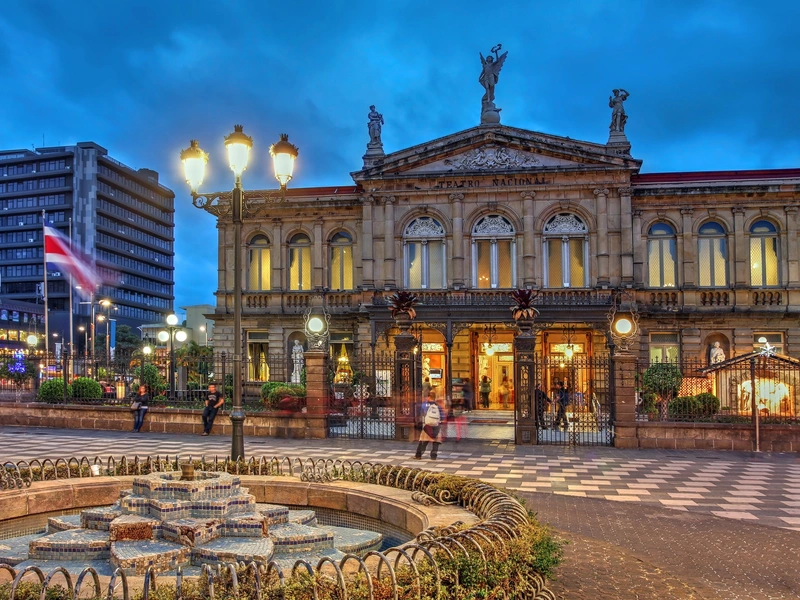
National Theater. Built in 1897 and finished in neoclassical style, this is San José's signature landmark, a block from the Plaza de la Cultura. Guided tours run through the lobbies, auditorium, and foyer. Note that an exterior restoration project has been under a court-ordered pause since early 2026 after damage from earlier repair work, so check current visiting conditions before you go.
Gold Museum (Museo del Oro Precolombino). An underground museum beneath the Plaza de la Cultura holding pre-Columbian gold work from across Costa Rica. Open every day of the week, making it one of the easiest stops to plan around a flight schedule.
Jade Museum (Museo del Jade). Housed nearby, with one of the world's largest collections of American jade alongside Costa Rican pottery and stone work. A combined ticket with the Gold Museum and National Museum is worth it if you plan to see more than one.
Central Market (Mercado Central). Open since 1880 and still the city's real working market: produce stalls, sodas serving casados, and vendors selling painted ox carts and leather goods alongside fresh fish and coffee. Go in the morning for the freshest food and the smallest crowds.
Day trips from the city. San José's location in the Central Valley puts Poás and Irazú volcanoes, the Orosi Valley, and several coffee farms within an hour or two by car, all doable as day trips without changing hotels.
Juan Santamaría International Airport (SJO) is Costa Rica's busiest airport and the arrival point for nearly all international flights, located about 12 miles northwest of downtown in Alajuela province. Unless your trip starts at the smaller Liberia airport in Guanacaste, this is where your Costa Rica vacation begins, whether or not you spend a single night in the city itself.
San José sits at roughly 3,600 feet in the Central Valley, which gives it a noticeably milder, drier climate than the coast. Daytime temperatures hold in the mid-70s Fahrenheit most of the year, dropping into the 60s at night. Dry season runs December through April and is the most reliable stretch for clear skies. Green season, May through November, brings afternoon showers, with September and October the wettest months. Either season works for a short city stop, since San José rarely sees the heat or humidity of the beach towns.
Most visitors fly into Juan Santamaría International Airport (SJO) and head straight to the coast or mountains the same day. San José works well as a one or two night stop if you want museums, city food, or a buffer before an early flight home, but it is not usually where people build a full-length vacation.
Yes. Juan Santamaría International Airport (SJO) sits about 12 miles northwest of downtown San José in Alajuela province, and it is the country's busiest airport and the arrival point for nearly every international flight into Costa Rica.
The Museo del Oro Precolombino is open daily from 9:15 a.m. to 5 p.m., including weekends, and closes only on a handful of national holidays. Admission runs around 16 dollars for foreign visitors. A combined pass covering the Gold Museum, Jade Museum, and National Museum is also available for about 33 dollars.
San José sits at roughly 3,600 feet in the Central Valley, which keeps it noticeably milder and drier than the beach towns. Daytime temperatures run in the mid-70s Fahrenheit year round, dropping into the 60s at night in dry season and further in green season. Dry season runs December through April and green season runs May through November, with September and October the wettest months.
A walkable loop covers the Gold Museum and Jade Museum near the Plaza de la Cultura, the National Theater a block away, and the Central Market for lunch and souvenirs. Many visitors also use San José as a base for day trips to Poás or Irazú volcano, the Orosi Valley, or coffee farms in the surrounding hills.
Tell us your dates and where you want to end up, we will map out San José, transport, and the rest of the country around it.
Talk to a concierge