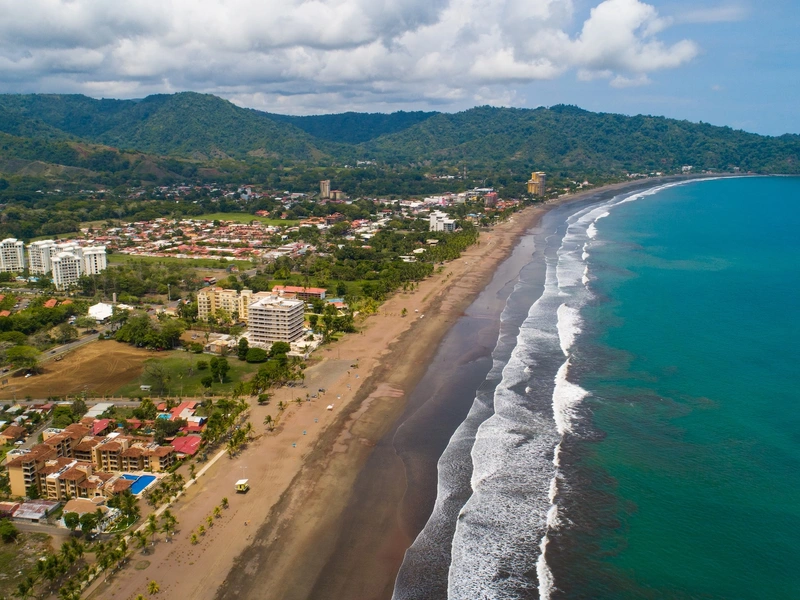
Jacó is the beach town closest to San José, and it has the energy to match: a long stretch of sand lined with surf shops, open-air restaurants, and a nightlife scene that runs later than almost anywhere else on the Pacific coast. Where Manuel Antonio and Uvita trade on rainforest quiet, Jacó trades on convenience and momentum, it is where a lot of travelers land first, learn to surf, and decide whether they want more of that pace or less.
The town itself is compact and walkable, with the beach on one side and a single main strip on the other. It draws a mixed crowd: surfers chasing a consistent break, groups here for the nightlife, retirees and expats who have settled in permanently, and families using it as a base for day trips up and down the coast.
Surfing. The beach break right in town is forgiving enough for first-timers, and surf schools line the beach road offering lessons and board rentals every day of the year. More experienced surfers head slightly farther out for faster, more powerful breaks.
Nightlife. Jacó has the widest range of bars, clubs, and late restaurants of any beach town on this coast, concentrated along a few walkable blocks.
Los Sueños Resort and Marina. About ten minutes away in Herradura, Los Sueños is a major sport fishing marina known for offshore marlin and sailfish charters, plus a marina village with restaurants and shops.
Carara National Park. A short drive north along the coastal highway, Carara is one of the most reliable places in the country to see wild scarlet macaws, along with crocodiles along the nearby Tarcoles River.
The beach itself. Jacó's beach is long and easy to reach on foot from almost any hotel in town, good for an early swim or a sunset walk even on days without a plan.
Jacó is the closest major beach destination to San José. Most travelers drive from Juan Santamaría International Airport (SJO), about 100 kilometers via Route 27 and Route 34 toward Orotina, typically one and a half to two hours depending on traffic, with roughly 5 dollars in tolls along the way.
Dry season, December through April, brings the most consistent sunshine and the busiest stretch for both beach crowds and nightlife. Green season, May through November, brings afternoon rain but is also peak surf season, with June and July offering the most consistent swell. Surfers chasing bigger waves should aim for green season, travelers who want sun and a livelier social scene should aim for dry season.
About 100 kilometers by road from Juan Santamaría International Airport (SJO), typically one and a half to two hours depending on traffic. The fastest route runs via Route 27 and Route 34 toward Orotina and carries roughly 5 dollars in tolls.
Yes. Jacó has a beginner-friendly beach break right in town plus several nearby breaks for more experienced surfers, and surf schools operate year-round. Peak swell season runs roughly May through October, with June and July especially consistent, though the bigger, more powerful waves in that window suit intermediate and advanced surfers best.
Los Sueños Resort and Marina, about ten minutes away in Herradura, is a major sport fishing marina and a good base for offshore charters. Carara National Park, about 15 kilometers north, is one of the most reliable places in Costa Rica to see wild scarlet macaws.
Carara sits right off the coastal highway a short drive north of Jacó, close enough for a half-day trip. Entrance tickets must be purchased online in advance through Costa Rica's SINAC system, entry runs about 10 dollars for adults, and hours are 7 a.m. to 4 p.m. in dry season and 8 a.m. to 4 p.m. in green season.
Dry season, December through April, brings the most sunshine and the busiest nightlife and beach crowds. Green season, May through November, brings afternoon rain, fewer crowds, and the best surf swell of the year.
Tell us your dates and what you love, we will match you with the right stay, tours, and transport.
Talk to a concierge